Maja Metera
February 12, 2026
How Childhood Shaped Your Kink

written by Micah Brown
I think when we approach this topic, we need to start by dispelling some commonly held, but completely incorrect, beliefs about how people become kinky. While many believe that a traumatic childhood leads to kink, that’s not the case. A person can have a perfectly normal childhood with no trauma and still end up kinkier than an overgrown poodle’s hair. Others may experience a vast amount of trauma in their childhood and be as vanilla as French Vanilla ice cream. What we want to look at today is, regardless of the type of childhood you had, how your experience growing up ended up shaping the kinky individual you are today.
In the Beginning
We’re all born, we all go through similar biological steps as we grow up, but our experiences will be different. We cannot compare our upbringing with others who may have been brought up in similar situations simply because even small differences can have a big impact on our development and outlook on the world. Very intelligent people have done decades of research around the ideas of Nature vs. Nurture in how somebody ends up growing up, and the (very loose) consensus here is that it’s a little bit of both.
How does that tie into what makes us kinky and what draws us to specific kinks? Well, let’s dive into that a little more deeply. What I can say right off the bat is that I am not an expert on this topic, but I am someone who is very interested in it, based on my own experiences in childhood and how I ended up becoming the Sadist Dominant I am today.
I remember looking at the cover of my brother’s Advanced Dungeons and Dragons guidebook and seeing a terrifying monster holding a scantily clad woman who had been scraped up and was bloodied and thinking that she was absolutely beautiful. Did that lead to me being obsessed with blood play the way I am? It was an impressionable time for me when I first saw that image, so perhaps that unlocked something in the back of my mind that would eventually lead me to where I am today.
As I grew older, I would have erotic dreams about causing pain to women, but not against their will. Instead, they enjoyed it and wanted it to happen to them. It wasn’t something I discussed with anybody because it just seemed like my brain was wired completely wrong, and on some level, I was worried I was some kind of psychopath.
Remember folks, there was once a time when the internet didn’t exist and it wasn’t easy to find information on kink in your high school library.
I’m sure there is somebody reading this who is now thinking that I must have been abused or molested as a child, and I can tell you assuredly that I was not. My parents divorced when I was 10, but I’d been fantasizing in unclear ways about the woman on the Dungeons and Dragons book before the divorce. When I was a little older, I lost a sibling to cancer, which is its own trauma – but that didn’t change my dreams or quiet fantasy life.
Surely I must have witnessed one of my parents being abusive to the other, in that case! Once again, not once. While my parents did divorce, from the perspective of the children, it was fairly quiet and simply the end of a marriage that had been good, but had come to an end. I was raised by loving parents who spent great deals of time with me whenever they could and never made me question their feelings toward me (much to my chagrin when I was in my rebellious teenage years and my dad was just cool with it – it’s difficult to rebel when your dad just kind of accepts it).
I never once wanted to cause pain to anybody who didn’t get some kind of enjoyment out of the act. I adored the thought of making a partner feel good by making them hurt, but I didn’t understand that people like that actually existed in the world until I reached college and met my college girlfriend, who was decidedly kinky and helped to guide me deeper into the realm of kink.
Respect
I know we spend quite a bit of time here talking about the various ways that people who aren’t kinky misinterpret kink, but here we go again…
There’s a difference in having a submissive who is female with whom long conversations and negotiations have occurred in order to assure that we’re both getting what we need out of the dynamic, and believing that ALL women should be subservient toward ALL men. One is a carefully agreed-upon understanding between consenting adults, and the other is simply misogyny.
Whether a submissive is male, female, gender-fluid, or genderless, it should be clear that in a healthy kink dynamic, they have chosen to be in their specific position.
I feel that my upbringing was very helpful in how I approach kink and my relationship with my slave. First of all, I was taught the importance of communication and how a breakdown in respect toward your partner can be the cause of communication failures, resulting in stress, frustration, and resentment within a relationship. Friends, lovers, kinky partners, and everything in between require respect to maintain trust and closeness. That goes doubly so for those who are in kinky dynamics.
Lack of respect in kinky dynamics and end up resulting in hurt feelings, hurt bodies (not in the fun way), or worse. I’m incredibly happy with how hard my parents pushed me to be respectful of my partners.
Now, if you were somebody who grew up in a household that didn’t teach respect or who actively displayed disrespect, and you ended up kinky, the likelihood is that your kinky nature existed already, and what you witnessed only helped to shape the direction it would grow in. Maybe you now enjoy a degradation kink and enjoy either being degraded or degrading your partner when in a scene. It gives you control over the lack of respect you once felt and allows you to own the entire experience.
How can you be respectful of your partner when you’re spanking them, calling them a dirty slut, and using them like a piece of meat for your own pleasure? By respecting their wishes within that scene. For somebody who enjoys being degraded, they deeply enjoy the act of it. What makes it work is simply that the Dominant in this instance doesn’t actually disrespect their submissive, and the submissive doesn’t actually feel worthless or like a dirty whore. When the scene is over, there will be aftercare where the Dominant will dote upon their submissive and make sure they feel loved, cared for, and comfortable. Yes, a scene like that can be very emotional, but sometimes that’s also the point.
Communication
I’m not going to spend a ton of time here talking about communication, but I’m also not letting it go unmentioned. Communication and how we communicate speak volumes for those of us in the kink community. We have to be able to clearly state our limits, talk about what we enjoy, what turns us on, and what turns us off so that when we’re in the midst of our scenes, we can let go of the worry and simply enjoy what’s happening.
How we are taught to communicate in our childhood will help to inform how we communicate in our adult lives and how we communicate within the kink community. Not everybody communicates the same way, and that’s to be expected. What is important is that we are able to understand the various ways our partners communicate because sometimes communication comes without any words at all.
I was always taught to speak up for what I wanted, expect not to get it, and to always ask politely. What’s interesting is that one of my best friends in childhood was raised a little differently.
I went to his house one day and there was watermelon out of the counter. I asked if I could have a slice. I would find out years later that his mother thought I was incredibly rude for asking (she was very southern) and that I should have waited to have been offered. There was nothing wrong with how I was communicating and there was nothing wrong with how his mother communicated. We just had different expecations of what communication was supposed to be in that instance.
The point here is that we were likely taught different communication methods as we grew up. Maybe those differences are vast, maybe they’re more subtle, but one thing that we should all be aware of now that we’re grown up is that we have to try and understand each other a little better and be sure that we understand where are partners are coming from so that everybody can be safe and feel respected.
Relationships
What were your friendships like when you were a kid? What sorts of games did you play with your friends and how did you go about speaking with them and understanding them? What did you talk about? How open were you with your parents? What did you hide from them? What did you share with them?
I’m specifically leaving out romantic relationships here because when you’re a kid, generally you don’t really have any (kid being under 13 in this case). Instead, the relationships you have with your friends and parents and family members are what inform the type of relationships you will eventually have with romantic partners.
All jokes aside, the relationship you have with your parents and the relationship you see between your parents (or step-parents) can have a huge effect on your romantic partners later in life. While my mom and dad got divorced, they both re-married wonderful people and demonstrated amazing relationships goals in their relationships. I learned that you don’t always have to agree on the small stuff to continue to be in love. You don’t have to like the same foods to keep a relationship going.
That provided me a good foundation to grow my respect and love for my partners. I believe it was also an important part in the comprehension of the need for understanding differences within my kinky relationships as well.
You may have had a very different childhood and a very different relationship with your parents. Maybe you learned the importance of respecting differences because your parents didn’t. Maybe you saw them being unhappy and decided that wasn’t what you wanted to see in your own relationships. Or maybe you had to go through some bad relationships before you learned what a good relationship was (don’t think for a moment that all my relationships were sunshine and roses – they were not – and I was often at the center of the issues as much as my partners were).
Concurrently, you may have learned more about good relationships by watching the parents of your friends (or maybe you learned about bad relationships that way).
Even having the best parents won’t protect you from bad friends and how we learned about bad friends and how we learned about dealing with feelings of betrayal. How did those experiences shape who you are now?
If you’ve been on the receiving end of a massive betrayal, it can deeply affect your relationships in the future. Having been in a relationship that ended up being incredibly bad for me at one point, my next relationship suffered because I hadn’t figured out how to trust after being betrayed, and I became overbearing and convinced every other male was trying to steal her from me. She was a good person. I was a paranoid asshat.
I used that experience to better myself as much as I could. I stepped back from relationships and re-learned how to trust before starting again. That’s not to say I didn’t have moments of paranoia or jealousy ever again, but I’d learned to manage them and talk about them and own them as things that were my problem and not my partner’s.
These experiences can absolutely color your kink as well. It may make you more cautious or it may awaken a new kink for manipulation play or betrayal scenes. Or it could take a completely unexpected direction.
We can look back and we can see these moments from our childhood that echo who we have become. Did you grow up with a deep sense of justice and now fight for those who cannot fight for themselves? Or maybe that deep sense of justice turned into a kink where the “bad guy” gets turned good after being seduced by the “good guy.”
Look at Yourself
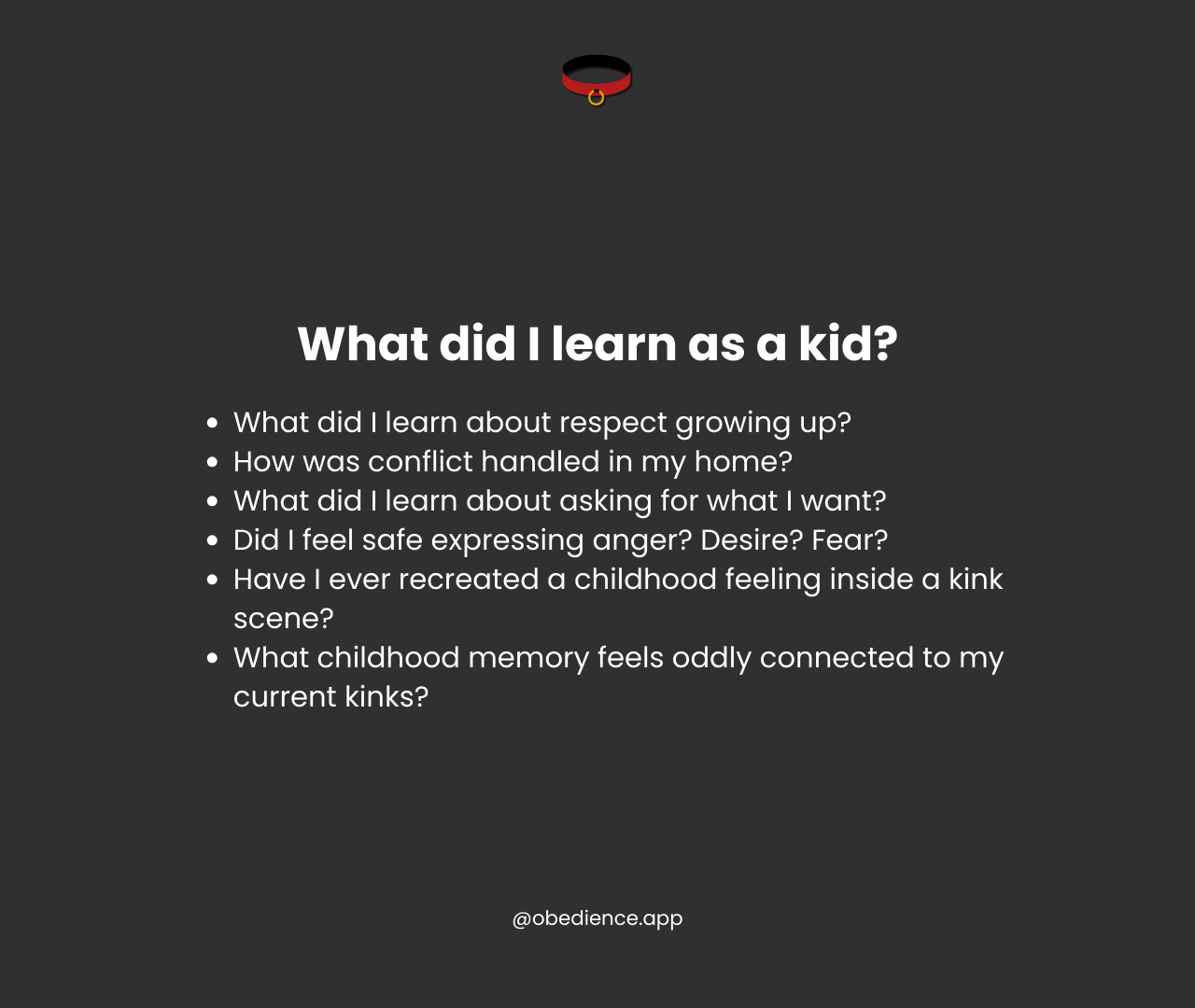
Look at who you have become and think about where you have been. Who have you been over the various parts of your life? What events may have shaped the you that you are now? What may have shaped the kinks that have become so integral to your life?
One cannot draw firm conclusions about anybody based on their childhood experience, but a direction can be found and followed. The best person to follow that is yourself. Take a look at your past and think about the things that may have indicated that you were going to grow up kinky and then look at the things that may have informed the various kinks that you would enjoy.
Our childhood plays a huge part of who we become. While it may be the shortest part of our lives in terms of years, it is still the most impactful part of our lives, and one that can be worth revisiting if for no other reason than learning more about who we have become.
.png)