Maja Metera
January 19, 2026
How Your Nervous System Affects Kink: Trauma, Fear Play, and the Science of Safety in BDSM

written by Micah Brown
If we want to learn more about ourselves and why we respond to the kinks we do, we don’t have to look any further than our own nervous systems. How our bodies respond to stimuli, trauma, fear, and danger can provide us with a plethora of information about why we like the kinks we like and why we respond to certain stimuli the way that we do.
Fight, Flight, or Freeze
When an animal is faced with danger there are three possible responses. We can either turn and fight the danger head-on in the hopes of frightening it away or hurting it enough that we can escape. We can flee (I can run faster scared than you can angry). Or we can freeze (Maybe if I don’t move, they won’t see me). These responses are ingrained in millions of years of evolution and have protected animals, including humans, since the first forms of life developed big enough brains to realize what danger was.
The first thing we must realize about these responses is that they are all trying to achieve the same goal: Keep us alive. Our primal brains switch into overdrive when we’re faced with a threat, and we make the decision as to how we respond in a split second. It’s also important to note that a flight response can become a fight response and vice versa. If we’re fighting and realize we’re in trouble, we may choose flight. At the same time, if we realize that we cannot escape, we may then turn to fight.
The freeze response tends to be a little different. You may go from a freeze response to a fight or flight response, but you likely won’t find yourself going from fight or flight to freeze. One of the more common issues, if you can call it that, with the Freeze tendency is that it isn’t uncommon for an animal to remain stuck and unable to move, even when the danger has spotted them and closed in. Against a predator, this freeze response could actually save a life – by hiding and not moving the predator could overlook you. But our nervous systems don’t always differentiate between a predator and other sorts of danger.
It's this freeze response that is often responsible for the deaths of people and animals in a house fire. Instead of finding a way to flee from the flames, an individual or animal may freeze, unable to make the decision that would otherwise save their lives.
As we learn more about other animals, we find that their experiences as well may be partially molded by trauma, but not to the extent that humans become affected by traumatic events – and even within the human species, different people will have vastly different responses to trauma. Some may not experience PTSD after an event, while others who were at the same event may suffer from PTSD for the rest of their lives if not treated. All this to say, we cannot judge somebody else’s lived experience on our own because it’s not fair to them or to us.
Our Nervous System and Kink
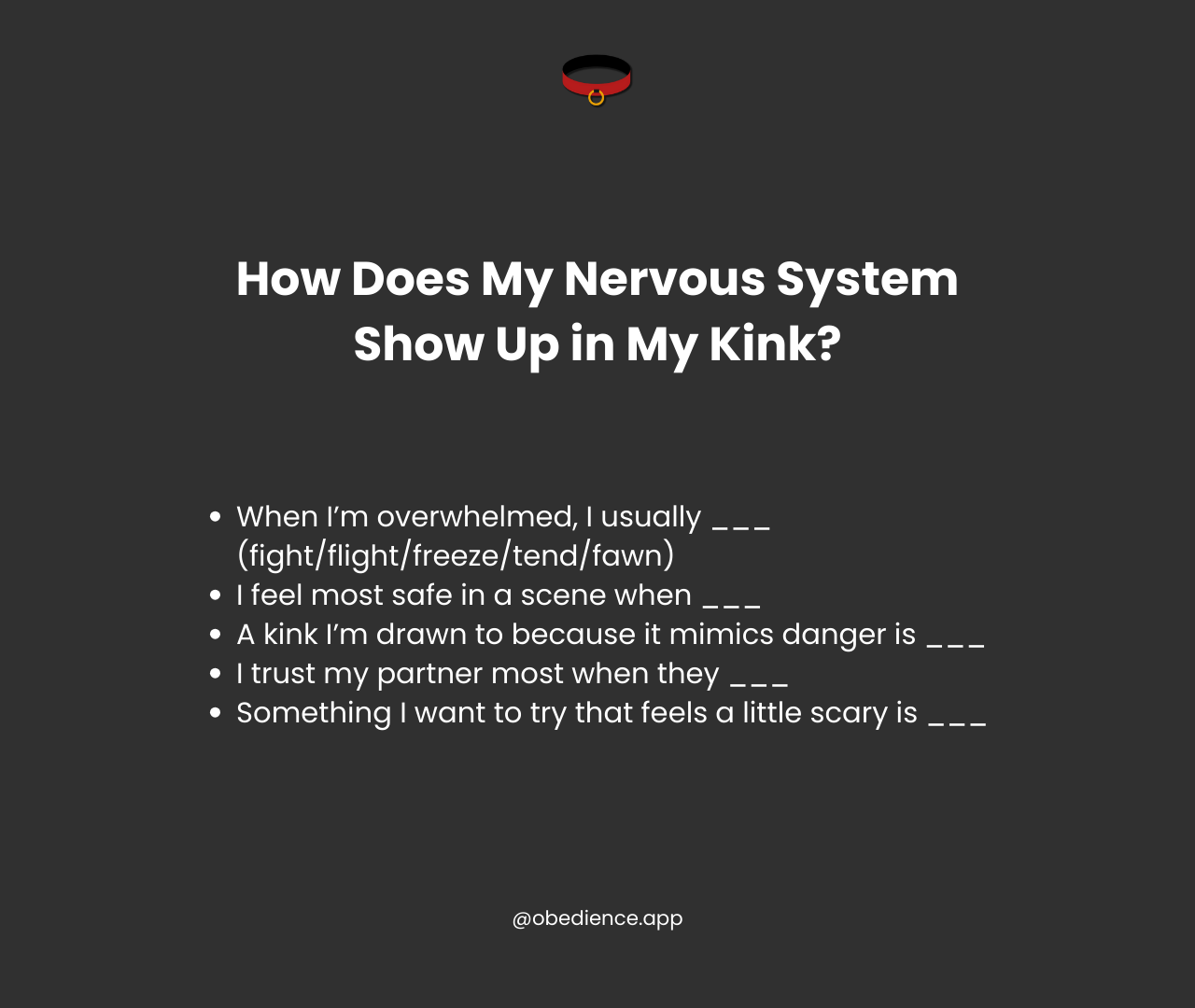
What does any of that have to do with our desire and our kink? The interesting thing about kink is that we often purposefully put ourselves into situations that create fear and activate our fight, flight, or freeze response while also maintaining a sense of safety because we’re experiencing this with somebody we trust and who is helping to guide us through the experience.
One of the more unique things about those who find themselves living a kinkier lifestyle is that they also happen to be more well-adjusted and more in touch with their emotions, both within themselves and with those they care about. We’ve touched on this before in this space, but as a quick refresher, it’s thought that this is due to the high amounts of communication that must be present within a kink dynamic for everybody to feel safe, seen, and cared for. Even though many of the activities that may occur during a scene are decidedly unsafe, the fact that we are performing these acts with somebody we trust and with whom we have discussed all the possible outcomes if something goes sideways, helps those involved in the scene feel safe in the moment.
There is so much variety around how people respond and what our psyches are like that it would be impossible to write something that touched on everybody’s experience if I had an unlimited number of pages and words to work with, but as that is not the case, I will do what I can to help each type of person feel seen and appreciated. If I’m completely off on something you feel could be directed at you, just know that I could be spot-on for somebody else.
Disclaimers aside, it’s important to think about the type of person you are in a real-world situation that involves danger and the type of play you enjoy when it comes to kinky experiences.
Structure and submission
While we mentioned it briefly above, how your nervous system responds external stimuli can very well inform your kink. It’s easy to simply put down here that those may choose flight in the real world could be interested in Primal play with Take-Down, whereas somebody who leans toward fighting could be seen as enjoying rough CNC play. That sort of thinking is an oversimplification that leaves out all the nuance
Let’s first talk about nervous systems and structure. We’ve touched on this in the past in various ways, but let’s focus on this in a way we haven’t before.
For many, especially those who may have suffered trauma, a lack of structure can cause stress and hasten somebody’s decent into depression and burnout. Structure doesn’t always mean organization around the house, but that is certainly helpful to creating structure within your life. For those who may need structure but cannot provide it for themselves, you may find yourself leaning toward a submissive role with a Dominant who can help guide your life and keep things structured. This goes beyond clutter around the living space and delves into structure around how one is living as well.
While there are many who thrive within a cluttered looking space, we must remember that often there is a sense of organization in their own mind. If you’ve ever seen photos of Einstein’s desk, you’d think he couldn’t have done any work or found anything in what appears to be a disaster.
But let’s move past structure within the living space and instead focus on the structure of one’s day, week, month, life, and year. This isn’t a “how to” on structure, mind you, but more of a dive into why being a submissive with a Dominant who provides structure could benefit your psyche.
As somebody who struggles to get out the door on time, eat a proper breakfast, or do the cleaning in a timely manner, it can be difficult to get started on creating the structure you need, even if you understand all the steps you need to do to build that structure. It can feel overwhelming to even start, so you may feel it’s less work to just continue on with the level of stress you currently exist in.
With my slave, creating structure for her was a game-changer. Helping build a morning routine, providing structure for how to approach stress during the course of the day, and giving a breakdown on what needs to happen when she gets home has taken the pressure off her to know what to do and when to do it. In addition, there’s a psychological shift when she is doing these things for me as opposed to when she’s trying to do those things for herself – but at the same time, she is actually doing these things for herself because the stress of them has melted away.
This isn’t a magic bullet to fix all the chaos in your life, and you shouldn’t try to find a D/s dynamic just to have somebody help structure your life, but it is a way to better understand your needs and your psyche.
If you do not have a dynamic at this time, you may want to try using something like the Obedience app to help create your own structure and “Dom” yourself a little into building that structure yourself.
One additional note I should toss in here is that if you happen to be a Dom who struggles with structure for yourself, helping your submissive to build structure into their own lives can actually help you build structure into your own life. Don’t count on your submissive to provide your structure, but you can create tasks and habits for both of you that help to enable each other’s structure.
Kink and Fear
Fear and fear responses can be a big part of kink. If they weren’t, CNC, fear play, and other types of play that create a fear or anxiety response wouldn’t be something that people would engage in. They can also be ways to help those who enjoy that type of play let go of stress and anxiety within their lives and even deal with trauma.
While we did a whole deep dive into fear play last year, I think it’s important to revisit that here. Knowing that you’re in a safe environment on the logical level of your brain doesn’t mean that the animal part of you still isn’t terrified of what is about to happen or what is happening. The important things to know in these situations is when you need to stop should your body become too overwhelmed or the fear too great.
What does being terrified do for our nervous system and our stress responses? How does being afraid end up being helpful for our psyches?
Much like people who may enjoy horror movies, those who enjoy some (or a lot) of fear in their kink play enjoy the rush of adrenaline that occurs when fear is triggered and the sense of relief that comes when the fear has passed and we’re still okay. It’s endorphins that can come on the other side of fear that create a sense of calm and wellbeing – and those chemical reactions can help reduce stress over all within our bodies. We’ve just experienced something terrifying and survived it. The relief we feel is real, even if we knew that we were never in real danger with our partner of choice.
On the other side, we have those people who may enjoy causing that sense of fear in their partner. It’s not because they wish to do actual harm to them, but because they know at some level when that fear leaves, the endorphins come in and set up shop and make their partner feel amazing. Fear play can lead to stronger orgasms and more satisfying sexual experiences for those who enjoy this type of play.
Knowing When to Slow Down, Pause, or Take a Full Break
It is vitally important that we know our own limits when we’re taking part in kink play. And more than that, it’s important that we understand our own bodies and minds. Even if we consent to something that we have enjoyed repeatedly in the past, it is possible that something may trigger an unexpected response and be cause for us to need to slow down or even stop the play. There is nothing wrong with this or with you should this happen.
You do want to make certain that you’re paying attention to yourself so that you understand when you need to slow down, pause, or take a break. Feeling lightheaded within the scope of any kind of fear-based play is common, but you need to know the point at which it starts to lean toward you passing out and if you fear that may happen, it’s time to slow down or take a break. While there are those who maintain a “consent in the event of unconsciousness” the likelihood is that they are already aware of all the dangers and have talked at length with their partner about how to approach this and what is and is not okay. Even if it sounds hot to you, don’t jump right into this sort of play.
This is the point at which I also reiterate the need for safe words in your play. Even if you’ve been playing together for years, it’s always good to have a safe word “just in case.” To keep it simple, my partner and I use the Traffic Light method with Green Light meaning everything is all good, Yellow Light means to slow down, and Red light is an immediate stop. Using this method is good because it means the Dom can check in if they are worried about your state of mind. They can ask, without interrupting the scene, if everything is still a Green Light so you can take a moment to investigate your current state of mind without having to stop the play.
The nice thing about having a Yellow Light option is that it means play doesn’t need to stop right away. You can say “Yellow Light” and have your Dom back off the intensity of the activity until you’re in a place where you can say “Green Light” again.
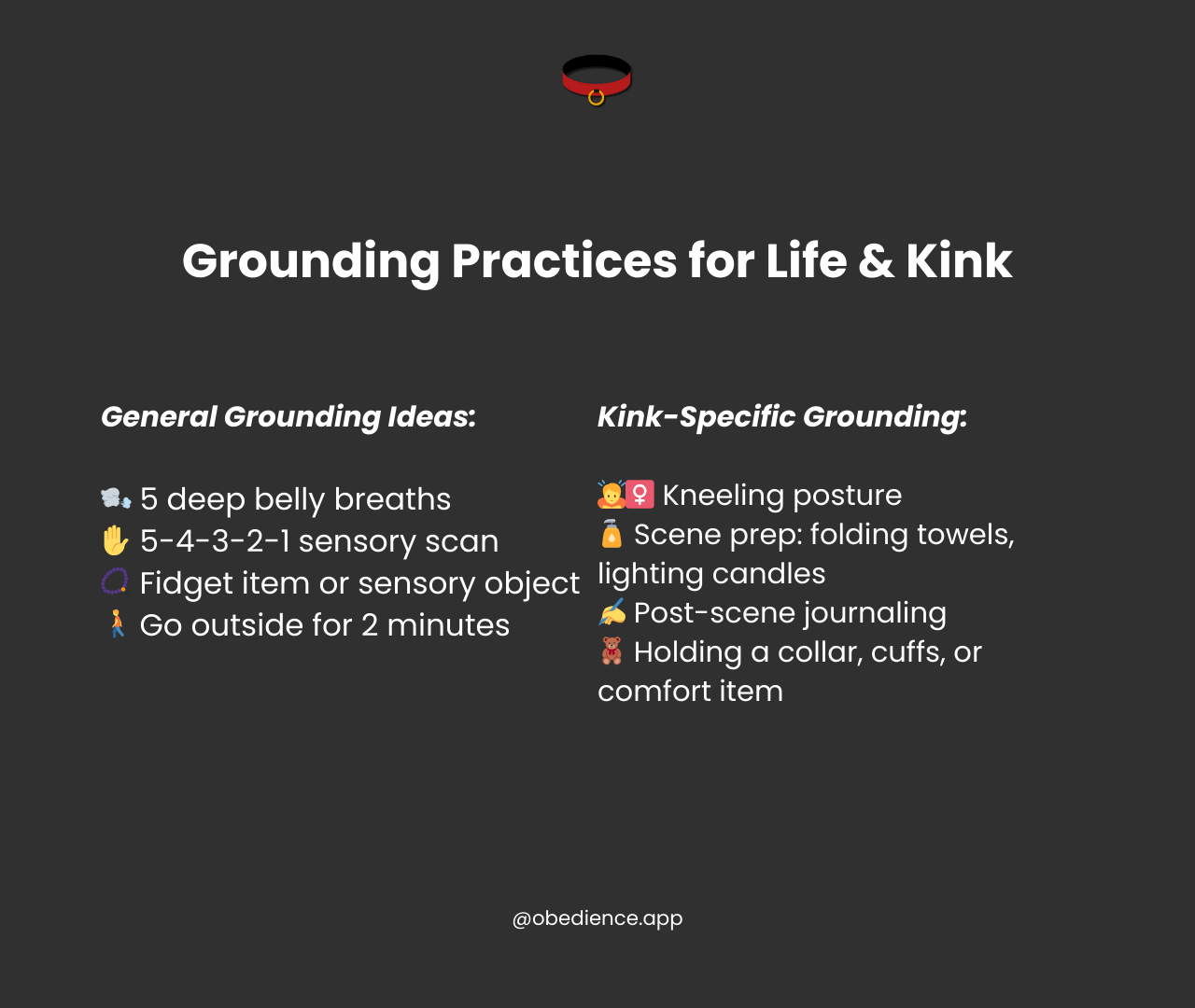
Grounding Yourself for Life and Kink
Staying grounded is important both in everyday life and when it comes to kinky play. In a world that is full of uncertainty and stress, taking that time is vital. So, how can we stay grounded within our daily selves and our kinky selves?
Here are some quick ideas to help you stay grounded:
Every morning spend at least one minute in quiet meditation – gradually increase that to five minutes if possible
Take at least one break during your workday where you spend one minute just concentrating on your breathing – you don’t need to meditate or spend more than a minute doing this, just concentrate on each breath you’re taking
When you get home from work, take two to five minutes to decompress by doing some deep breathing – you can mediate during this time, but just taking those deep breaths can help to ground you
What about staying grounded in your kinky life?
When meditating, take the time to consider your role in the dynamic – if you’re a submissive, think about your place as a submissive and how you can better server your Dom – if you’re a Dom, think about how you can help to guide your submissive more effectively and help keep their stress levels down
Take time to show your devotion to your Dom – if that means kneeling for them and presenting your submissive self to them, do that – if it means providing them with the things they need to relax at the end of the day, do that
Show your submissive how deeply you care for and appreciate them – remember, they have gifted you with their submission – show them how much that means to you
Conclusion
When talking about how your nervous system informs your kink, there could be an entire book focused on this (and there very well could be a book on this that I am unaware of). These are deep topics that will affect each individual differently. Even if you’ve experienced the exact same things as somebody else, you will still have processed those events differently. That’s what makes this topic so difficult to turn into something short and sweet. We have to dig deeper to get to the meat of all of it and then ruminate on all of it.
The important thing to remember is that we are all different and that we must all be patience with one another as we go through this journey. Keep open lines of communication at all times. Make sure everybody feels safe talking about tough subjects. Don’t be afraid to use a safe word if you have to.
Keep yourself grounded. Pay attention to your body. Don’t let anybody else tell you what you are or should be feeling.